Lead-Free Brass Max-Adapter – 3/8″ Compression Outlet
The Compression Outlet Lead Free Brass Max-Adapter is designed specifically for potable water applications. It suits plumbers and installers who need a trustworthy 3/8 female connection. This 3 8 female to 3 8 male adapter combines a robust lead-free brass body with a factory-fit nut and sleeve. It provides a serviceable compression outlet compatible with small-diameter tubing and typical flexible connectors.
Plumbers, contractors, and facilities managers will appreciate its construction. Lead-free brass ensures code compliance, while Delrin (POM) sleeves give compatibility with plastic tubes. Its typical working limits are around 125 PSI and up to 160°F. As a result, the Max-Adapter fits well in most residential and lighter commercial potable applications.
Available through wholesale distributor Installation Parts Supply, the Compression Outlet Lead Free Brass Max-Adapter is sold alongside related parts. These related items include 3/8 to 3/8 compression adapters, 3/8 compression plugs, and 3 8 female to 3 8 male adapters. Always confirm part numbers and what components are included with the distributor before placing an order. This ensures compliance with the Buy American Act or local procurement requirements.
Lead Free Brass Max-Adapter – Compression Outlet
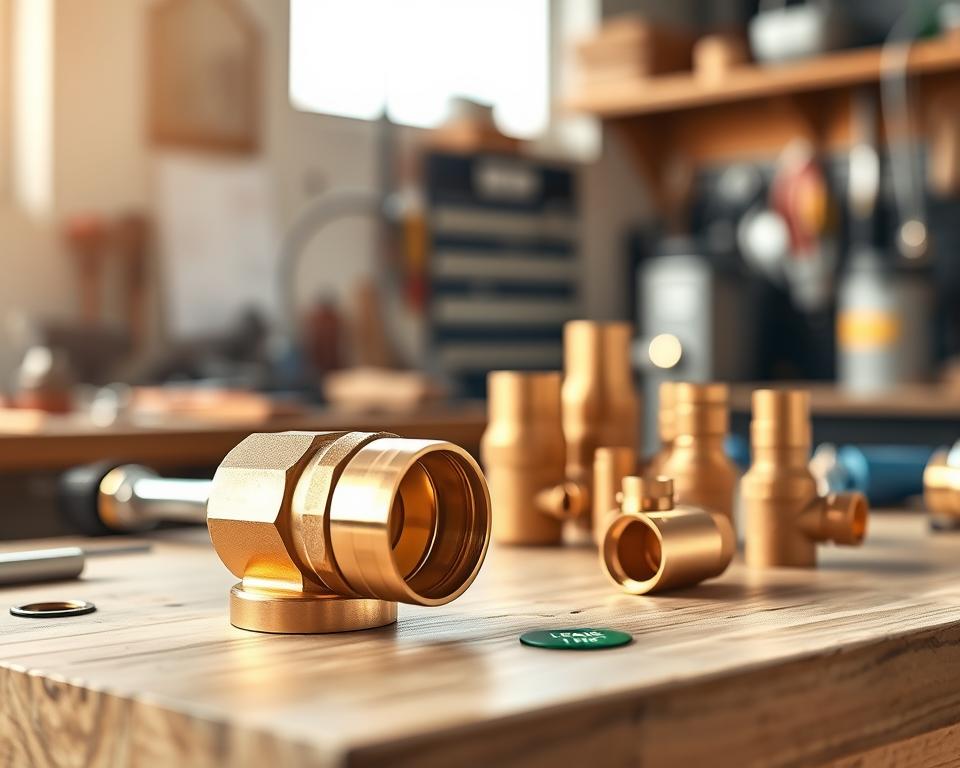
The Compression Outlet Lead Free Brass Max-Adapter is designed for use in potable-water service and common household hookups. Its lead-free brass body resists corrosion and meets code requirements for drinking water. Designed for 3/8″ OD tubing, it pairs nicely with flexible braided supply lines used on faucets, toilets, and icemaker hookups.
Product overview and key features
Typically, this Max-Adapter is supplied as a kit with a body, nut, and sleeve. Check the included parts with Installation Parts Supply or the distributor to verify the exact SKU contents. The compression outlet configuration suits 3/8 compression adapter sizing and works on copper tube types K, L, M, and ACR. It also supports many soft plastic tubing types when used with the correct sleeve material.
You can mate this adapter to standard threaded ports built to US NPT thread standards. Select an appropriate 3/8 female to 3/8 male adapter whenever mixed-thread transitions are required. For retrofits, a 3/8 to 3/8 female adapter option can simplify joining flexible connectors to existing lines.
Key specifications and working limits
Typical working limits for comparable lead-free compression fittings are around 125 PSI and 160°F. These figures match common examples such as Watts AquaLock female adapters and provide a useful performance baseline for domestic plumbing tasks.
Materials used include a lead-free brass body with Delrin/POM sleeves for potable-water use on plastic tubing. Brass sleeves are meant exclusively for copper tubing. Threading follows US NPT standards, where MIP/MPT denotes male threads and FIP/FPT denotes female threads.
| Key attribute | Typical spec | Additional notes |
|---|---|---|
| Tube OD intended | 3/8″ (equals 1/4″ CTS nominal) | Matches common 3/8 compression adapter sizing |
| Recommended working pressure | Up to about 125 PSI | Typical for domestic hot and cold water service |
| Typical working temperature | 160°F | Covers most residential fixture supply temperatures |
| Body material | Lead free brass | Compliant for potable-water systems |
| Sleeve options | Delrin (POM) or brass sleeves | Delrin for plastic tubing, brass for copper |
| Threading standard | US NPT / MIP / FIP | Use correct 3/8 female to 3/8 male adapter for threaded transitions |
Advantages of lead-free brass compression fittings in plumbing
Lead-free brass compression fittings provide notable benefits in water system design. They meet NSF and many state standards for drinking water, making them ideal for kitchens, bathrooms, and public projects. For municipal jobs, request specification sheets and submittal data from Installation Parts Supply to ensure compliance with the Buy American Act or local procurement rules.
Health benefits and code compliance
Lead-free brass alloys help significantly reduce contamination risk in domestic water supply lines. Many jurisdictions now mandate low-lead fittings for potable-water connections. When used on plastic tubing, Delrin (POM) sleeves are also appropriate for potable-water systems. Using code-compliant parts avoids expensive rework, satisfies inspectors, and safeguards building occupants.
Durability and serviceability
Brass bodies offer better corrosion resistance than many alternatives, supporting a long service life under typical conditions. Working limits around 125 PSI at 160°F are suitable for the majority of residential and light commercial installations.
Compression fittings allow for maintenance without cutting pipe runs in many cases. Service personnel can disassemble unions to swap out valves or connectors. Remember that brass sleeves generally deform on copper during compression and should not be reused, so include sleeve replacement in service planning.
Compatibility and versatility of use
These fittings are compatible with copper tube types K, L, M, and ACR, and they pair well with flexible braided connectors from brands such as BrassCraft, Watts, and Matco-Norca. By combining compression fittings with push-to-connect adapters, you can bridge between various piping materials.
Popular adapter types here are the 3/8 valve adapter, 3/8 female compression adapter, and 3/8 to 3/8 faucet adapter. These options simplify faucet installs and replacement valves without major rework. They are well-suited to lines with low vibration and low-to-medium pressure. For high-vibration lines or larger plastic piping, consider PEX-specific or push-fit solutions instead.
| Feature | Lead-free brass compression option | Typical Alternatives |
|---|---|---|
| Potable-water compliance | Meets NSF/ANSI and many state codes when properly certified | CPVC/PVC have their own approval paths; legacy brass fittings may fail modern standards |
| Ease of service | Field serviceable; unions and adapters removable | Push-fit easy to install; some are not intended for repeated reuse |
| Durability | Strong corrosion resistance and long service life under standard conditions | Some plastic fittings deteriorate when exposed to UV or high heat conditions |
| Typical adapter choices | Includes 3/8 valve adapters, 3/8 female compression adapters, and 3/8 to 3/8 faucet adapters | Push-fit connectors, PEX crimp fittings, threaded brass adapters |
| Typical limits | Around 125 PSI and 160°F for a large share of models | Ranges vary; always consult the manufacturer’s data sheet |
Operation of compression fittings and installation best practices
Compression fittings create a strong, solder-free connection for copper, PEX, and plastic tubing. Here you’ll find an explanation of the components, a step-by-step installation process, and frequent errors to watch for. In particular, it centers on the Compression Outlet Lead Free Brass Max-Adapter and similar fittings.
Anatomy of a compression fitting
A standard compression fitting has three basic components: the body, the compression sleeve (ring), and the nut. Multi-outlet versions include a separate sleeve and nut for every outlet connection.
Sleeves are typically brass for copper tubing and Delrin (POM) for soft plastics such as PEX and LLDPE. Choosing the right sleeve is critical for a tight, lasting seal.
Step-by-step installation guidance
1. Cut the tubing square, then ream both the inside and outside to eliminate burrs. A clean, square end is crucial for a reliable seat.
2. Slide the nut over the tubing first, followed by the sleeve. For plastic tubing, insert a stiffener before installing the sleeve.
3. Push the tubing fully into the fitting body until it seats. Confirm full insertion visually and by feel.
4. Tighten the nut by hand, then finish with a wrench, turning about one-half turn beyond finger-tight. For harder metals or thin-wall tubing, you may need an extra quarter turn.
5. Do not use PTFE tape on compression joints. Tape is for threaded pipe connections. If threads bind, a small amount of food-safe lubricant on the nut threads can help, but avoid touching the sleeve or sealing surface.
Common mistakes and how to avoid leaks
Using brass sleeves on soft plastic tubing can cut into the tube and create leak paths. For PEX and LLDPE, always select Delrin sleeves rather than brass.
If you over-tighten, you risk crushing the sleeve and deforming the tubing. Stick to the recommended turn count and stop when the joint becomes snug and resists further turning. Do not reuse a brass sleeve that has been deformed; it typically will not seal properly again.
Omitting pipe stiffeners on soft plastic tubing causes deformation and early leakage. Stiffening inserts are low-cost components and are essential for reliable compression fittings on plastic lines.
| Issue | Likely cause | Fix |
|---|---|---|
| Slow drip from joint | Not tight enough or tubing end cut out of square | Cut the tube square, refit, and tighten according to the specified turns |
| Tubing burst or split | Excessive tightening or missing stiffener on plastic tubing | Replace tubing and sleeve, use stiffener, limit wrench turns |
| Leak after reusing fitting | Brass sleeve reused after permanent deformation | Install a new sleeve and nut and avoid reusing old sleeves |
| Fitment mismatch | Wrong sleeve material or wrong adapter size | Check sizing and materials; if needed, use a 3/8 compression plug or a 3/8 to 3/8 compression adapter |
Before assembling a Compression Outlet Lead Free Brass Max-Adapter, verify both fitting size and sleeve material. Maintain a 3/8 compression plug and a 3/8 to 3/8 compression adapter in your kit for routine service. Good preparation and controlled tightening make compression fitting installations both quick and long-lasting.
Sizing, compatibility and related adapters (3/8″ compression family)
A solid grasp of the 3/8″ compression family helps you select the correct components for fixtures, valves, and transitions. Because these fittings are sized by outside diameter (OD), this section will clarify how OD and CTS sizing relate. You’ll also see a list of common 3/8″ adapters used across residential and commercial jobs.
Remember that compression fittings are specified by OD, not by inside diameter. As an example, 3/8″ OD tubing is considered 1/4″ CTS nominal. To prevent leakage, always use OD sizing when ordering and matching ferrules and nuts.
Quick OD-to-CTS references are essential on the job. For instance, 3/8″ OD equals 1/4″ CTS, 1/2″ OD equals 3/8″ CTS, and 5/8″ OD equals 1/2″ CTS. Keeping these conversions handy is crucial when working with copper and small-diameter plastic tubing.
Common 3/8″ adapters and related keywords
Common parts in the 3/8″ family include a 3/8 compression adapter for line transitions and a 3/8 tee adapter for branch feeds. Installers frequently keep a 3/8 to 3/8 female adapter plus a 3 8 female to 3 8 male adapter for fast hookups.
For shutoffs and faucet hookups, a 3/8 female to 3/8 male compression shut off valve or 3/8 to 3/8 faucet adapter is commonly used. It is smart to keep a 3/8 female compression adapter and a 3/8 compression plug in your kit for frequent repairs and retrofits.
When to choose compression fittings vs push or PEX fittings
Use compression fittings on copper and smaller plastic tubing where you anticipate needing disassembly and service. They are effective in low-vibration systems operating at low to moderate pressures.
For faster installation and reduced labor, use push-to-connect or PEX fittings. Push fittings save time when working with soft plastic tubing sizes that would otherwise require stiffeners or Delrin sleeves for compression connections.
Where to buy and wholesale distribution details
For project procurement and bulk orders, contact Installation Parts Supply as the primary wholesale distributor for the Max-Adapter line. Before placing large orders, verify availability, SKUs, pricing, and whether each part number includes the nut and sleeve.
Wholesale supplier information
Installation Parts Supply supports direct-to-job-site shipping and can provide submittal sheets on request. Request manufacturer part numbers and EAN codes so you can match spec sheets from brands like Watts and Viega for project documentation.
Common product pairings and frequently purchased items
Common companions for a 3/8″ compression Max-Adapter include flexible braided connectors used on faucets, toilets, dishwashers, and icemakers. Contractors often buy Delrin sleeves, pipe stiffening inserts, compression nuts, and a 3/8 compression plug for test and service work.
Transition fittings are common additional items. Examples include push-to-connect to compression adapters, a 3/8 valve adapter for shutoffs, and a 3/8 to 3/8 faucet adapter for finish connections.
Shipping, submittals, and compliance documentation
Request specification sheets, submittal data, and Buy American Act confirmation when working on public projects. Supplier documentation will confirm the maximum working pressure and temperature limits for the adapters and fittings.
When you buy compression fittings wholesale, verify whether plastic inserts or Delrin sleeves are included. Ask the distributor for manufacturer spec sheets to confirm code compliance and to document items such as a 3/8 valve adapter or a 3/8 compression plug for your submittal package.
| Component | Common use | Comments |
|---|---|---|
| 3/8″ valve adapter | Shutoff or supply tie-in | Verify male/female orientation and whether a nut is included |
| 3/8 to 3/8 faucet adapter | Finish connection to faucet tailpiece | Confirm sleeve material and threading style before use |
| 3/8″ compression plug | Temporarily sealing or testing unused compression ports | Keep spare plugs on site for commissioning |
| Delrin sleeves and inserts | Internal pipe support inside the fitting | Often sold separately from nuts |
| Push-to-connect transition | Quick tie-ins between systems | Verify pressure and temperature rating, for example 125 PSI / 160°F |
Ordering tip: ask Installation Parts Supply to confirm that your SKU includes all necessary components. Taking this extra step helps reduce returns and maintains project schedules when you purchase compression fittings in bulk.
Summary and conclusion
For potable water lines that need a reliable 3/8″ OD connection, the Compression Outlet Lead Free Brass Max-Adapter is a solid choice. Because of its lead-free brass body and Delrin sleeve compatibility, it works in numerous plumbing scenarios. It’s ideal for residential and light commercial use, ensuring a durable connection with common fixture connectors.
Prior to purchase, verify that nut and sleeve are included, confirm part numbers, and check maximum pressure and temperature ratings. Suppliers like Installation Parts Supply can verify Buy American Act status and provide compliance documents upon request. It is also helpful to list related components, like a 3/8 compression adapter, to ensure system-wide compatibility.
For optimal results, use Delrin sleeves and pipe stiffening inserts on PEX or soft plastic tubing. Avoid using brass sleeves on plastic pipe. Follow correct cutting, reaming, and tightening procedures to achieve leak-free connections. When installed correctly, lead-free brass compression fittings provide a long-lasting, code-compliant solution for water-supply needs.